The Next Frontier: AI-Driven Cybersecurity for a Changing Threat Landscape
(Optimised for MSSPs, CISOs, IT Leaders & Enterprise Decision-Makers)
Africa’s digital economy is expanding faster than its security capacity, and adversaries have noticed. Attackers are operating with unprecedented speed, precision, and automation — leaving traditional defence stacks struggling to keep pace. Organisations are asking tougher questions about visibility, response time, and operational resilience. MSSPs are under pressure to deliver outcomes, not dashboards. And CISOs are tired of “innovation” that creates more complexity than value.
That’s why the next wave of cybersecurity isn’t built around tools — it’s built around intelligence. AI-driven cybersecurity marks a step change in how threats are detected, prioritised, and contained. At Corr-Serve, our work with global leaders like Seceon brings these capabilities into African realities, enabling partners to operationalise real-time detection and automated response responsibly and measurably.
2026 won’t be defined by AI hype. It will be defined by AI adoption that delivers results.
A Threat Landscape Moving Faster Than Defenders
The observable signal across the continent is clear: attacks are accelerating while defenders are operating at human speed. Ransomware crews now automate lateral movement. Credential harvesting is industrialised. Cloud misconfigurations are exploited within minutes. And social engineering remains depressingly effective because it’s tailored, targeted, and now frequently AI-generated.
This shift creates a measurable gap in risk posture. Most organisations still rely on security operations that depend on human interpretation of logs, alerts, and incidents. When attackers automate reconnaissance, defenders can’t rely on analysts manually correlating events across firewalls, endpoints, identity systems, cloud logs, and network telemetry.
For MSSPs, the operational pressure is even higher. Customers expect speed. They expect context. And they expect an outcome — “Are we safe?” — not “Here’s your daily SIEM report.” Traditional SOC models, built around labour-intensive triage and rule-tuning, don’t scale against today’s high-volume, high-velocity threats.
The result is a widening gap between attack speed and defender capability. That is the signal driving the shift toward AI-driven cybersecurity. Not as a trend, but as a necessity. Automated analysis, machine-led correlation, and intelligence-driven response aren’t “nice to haves.” They’re the baseline for any organisation serious about improving its measurable security outcomes in 2026 and beyond.
What AI-Driven Cybersecurity Actually Changes
AI-driven cybersecurity isn’t about replacing analysts — it’s about augmenting them with a capability that operates continuously, consistently, and far faster than human teams alone. Two things become possible when AI becomes central to detection and response:
1. Real-time visibility across all security signals
Seceon’s approach to AI-driven threat detection exemplifies this. Instead of treating logs and telemetry as disconnected datasets, the platform treats them as a unified signal. Behavioural baselining, anomaly detection, threat intelligence, and machine reasoning combine into a continuous analytical cycle. This isn’t SIEM as usual — it’s correlation without the manual labour.
For engineers, the value is practical:
-
- fewer rules to tune
- fewer false positives
- clearer root cause trajectories
- a single observable signal instead of dozens of siloed data points
2. Automated response that reduces human load
When AI can identify malicious activity with confidence, responders can focus on decisions that matter. Automated actions — isolation, blocking, containment, policy adjustments — can be executed within seconds. In Seceon’s architecture, this is not a “bolt-on” automation; it’s built into the detection logic.
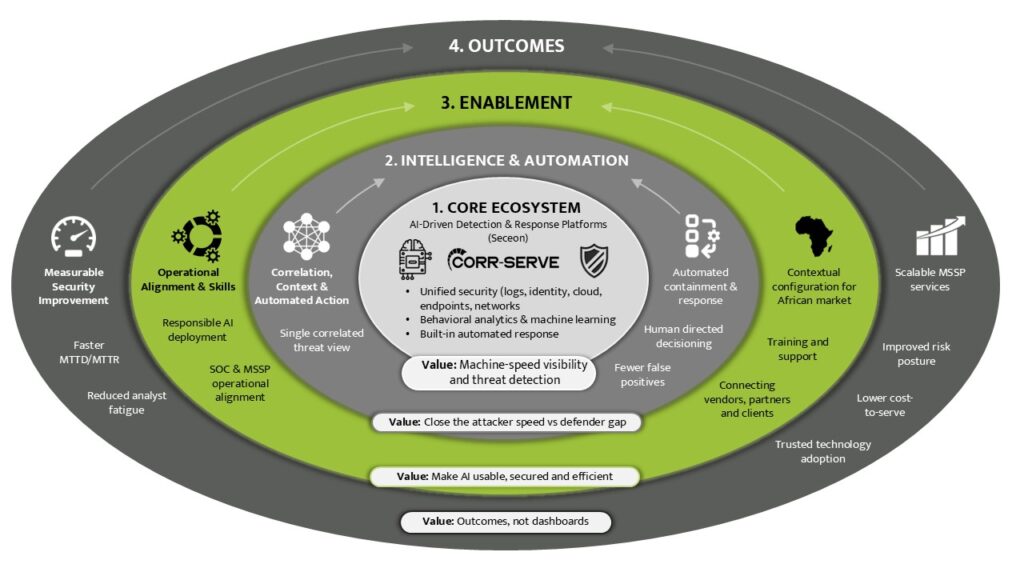
This is where Corr-Serve’s enablement focus becomes critical. AI only delivers value when:
-
- deployed responsibly
- aligned with each organisation’s operational realities
- understood by teams who must run it
- measured through outcomes, not noise levels
Our role isn’t simply to introduce Seceon to partners — it’s to ensure MSSPs and enterprises adopt the capability in a way that improves their measurable risk posture. That means training, operational alignment, contextual configuration, and continuous support.
AI-driven cybersecurity is transformative, but only when it becomes part of daily operations — not another blinking tool in the stack.
African Realities Shape AI Adoption
Africa’s security landscape is distinctive, not deficient. The realities shaping adoption here are clear and must be acknowledged, not glossed over:
1. Skills gaps and overloaded teams
MSSPs and enterprise SOCs are dealing with limited analyst capacity. AI’s value proposition here is immediate: reduce human effort without compromising detection quality. But that only works if the platform is operationally aligned from day one.
2. Infrastructure diversity
Many organisations operate hybrid environments: on-prem systems layered with multiple cloud platforms, legacy infrastructure, and modern SaaS layers. AI-driven platforms must be flexible enough to ingest and process that complexity without forcing rearchitecture.
3. Budget constraints and ROI sensitivity
Security leaders in Africa measure value through adoption and outcomes — not vendor promises. This is where Seceon’s model resonates: faster time-to-value, lower tuning overhead, and measurable threat reduction from early deployment.
4. MSSP-driven security maturity
Many mid-size enterprises rely on MSSPs for operational security. MSSPs need platforms that scale without adding headcount, improve detection accuracy, and allow them to offer higher-value services. AI-driven detection and automated response become competitive differentiators.
Corr-Serve’s role sits squarely at this intersection: responsible enablement that accounts for regional constraints while ensuring partners are equipped to operationalise advanced capabilities. We ensure AI adoption is aligned, contextualised, and measurable — not copy-pasted from other regions.
Why 2026 Is the Year AI Becomes the SOC Backbone
Global security operations are consolidating around intelligence-driven models. But in Africa, the opportunity is even more pronounced because the current gaps are wider — and solvable.
1. MSSPs can expand service tiers immediately
With Seceon’s AI-driven detection and automated response, MSSPs can:
-
- create differentiated service tiers
- reduce manual investigation overhead
- deliver consistent SLAs
- reduce the cost-to-serve per customer
This shifts revenue models from labour-based to capability-based.
2. Enterprises can materially improve their risk posture
Boards and regulators are demanding measurable security outcomes. AI-driven detection and response platforms create:
-
- faster mean-time-to-detect (MTTD)
- faster mean-time-to-respond (MTTR)
- better visibility
- fewer unmanaged blind spots
These are measurable improvements — not aspirational goals.
3. AI amplifies, not replaces, human expertise
The real strategic opportunity is not automation for its own sake. It is the combination of:
-
- machine-speed detection
- human judgement
- regional context
- operational alignment
That is where Corr-Serve and Seceon together unlock value.
4. Aligning technology to African operational realities
Africa doesn’t require watered-down solutions. It requires proven global capabilities delivered through models that fit regional conditions — bandwidth constraints, cost sensitivity, talent gaps, and hybrid architectures. That is the gap Corr-Serve fills.
2026 is the year AI-driven cybersecurity shifts from an emerging capability to an operational expectation. Partners who adopt early will lead the next cycle of service evolution.
AI-driven cybersecurity is no longer speculative. It is the practical path to closing the gap between attacker speed and defender capacity. With global partners like Seceon, Corr-Serve enables MSSPs, CISOs, IT leaders, and enterprises to adopt real-time detection and automated response technologies responsibly and measurably.
The opportunity is clear:
-
- Better visibility.
- Faster response.
- Fewer false positives.
- Less analyst fatigue.
- More resilient security operations.
But the differentiator isn’t the technology — it’s how effectively it is adopted and aligned to your operational realities. That’s where Corr-Serve equips partners with the training, context, and enablement required to turn AI into an outcome, not another promise.
If you’re ready to explore how Seceon’s AI-driven platform can strengthen your security operations, request a Corr-Serve partner enablement session.
Learn more here: https://corrserve.co.za/aisiem-aixdr/
We’ll help you evaluate fit, map capabilities to your environment, and build a path to measurable improvements in your risk posture.